 Twitter
 Facebook
 Flickr
 RSS
RSS
10 noviembre 2011
Quantz - Flute Concertos - R. Brown


Best known for her moving and virtuosic performances on a huge range of flutes and recorders, Rachel Brown is an acknowledged authority on historical performance practice, an inspirational teacher and an entertaining and illuminating speaker.
Whilst training on modern flute at Manchester University and the Royal Northern College of Music with Trevor Wye she won numerous prizes leading to performances of flute concertos by Ibert and Nielsen and went on to win the coveted American National Flute Association’s Young Artist Competition. She gave first performances of works by Robin Walker, John Ogden, Judith Weir and, for the Park Lane Group, Barry Guy. However, her interest in early music had already been captured by her recorder teacher, Ross Winters, naturally leading to study of the baroque flute with Lisa Beznosiuk and Stephen Preston and an exploration of the many diverse classical and nineteenth-century flutes.
Rachel’s recital discs of French Baroque Music and Quantz Sonatas (for Chandos) established her reputation and her recording of virtuosic works by Schubert and Boehm on simple-system, ring-keyed and Boehm alto flutes has been described as ‘a revelation’. As a soloist she has recorded extensively and toured in Europe, Japan and North America with a comprehensive concerto repertoire from J.S. Bach, Vivaldi and Telemann to Mozart. She has given many performances of the newly discovered Handel Flute Concerto and her championing of the works of the Berlin School has reawakened interest in the largely unknown masterpieces by Quantz. Her dazzling recordings of the Quantz and C.P.E. Bach Concertos (for Hyperion) have won international acclaim. Rachel appears on many Telemann discs with Collegium Musicum 90 (Chandos) and her recording of the complete Handel flute and recorder sonatas op.1 with the Academy of Ancient Music (for Harmonia Mundi) has been described as “enchanting”. She is a founder member and soloist with the London Handel Players with whom she has recorded three discs of Handel’s chamber music (for Somm), described as ‘perfection itself’. Rachel launched her own label, Uppernote, with a tour de force recording of the complete Telemann Fantasias followed by another new disc of virtuosic Quantz Sonatas, entitled Private Passion.
Equally at home in the wind section, Rachel has had a long and distinguished career as an orchestral player; first, on silver flute, with the orchestra of Kent Opera and for many years as principal flute with the Academy of Ancient Music, the Hanover Band, the Kings Consort, Collegium Musicum 90, Ex Cathedra and the Brandenburg Consort. An occasional guest principal with the Orchestra of the Age of Enlightenment, the English Concert, the erstwhile London Classical Players and orchestras abroad such as the Nederlands Bach Vereniging, the Orchestra of the Eighteenth Century and Tafelmusik, Rachel has also appeared as soloist with Arte dei Suonatori in Poland, the Haydn Akademie in Austria and Concerto Copenhagen in Denmark and Germany.
A dedicated teacher, Rachel has given masterclasses in the USA, Canada, Sweden, Poland, Spain, Ireland, Holland, Switzerland, France, Belgium, Croatia, Brazil and New Zealand. She taught for many years at the Royal Northern College of Music, followed by time at the Royal Scottish Academy of Music and Drama, the Birmingham Conservatoire and as lecturer in classical studies at the Guildhall School. She is currently professor of baroque flute at the Royal College of Music. Always enjoying working with children, Rachel has taught recorder at Wells Cathedral School and currently teaches flute and recorder at City of London School. She also runs her own music group for pre-school children.
Rachel is author of the Cambridge University Press handbook to The Early Flute and has composed cadenzas for the new Bärenreiter edition of the Mozart Flute Concertos. Following great interest in her research, Rachel has published two volumes of her favourite Quantz sonatas, supported by subscribers worldwide.

Mozart - Flute Concertos - S. Bezaly


Sharon Bezaly (Israel, 1972) es una flautista de reconocimiento internacional. Fue elegida "Instrumentista del Año" por la revista Klassik Echo en Alemania en 2002 y "Joven Artista del Año" en los Cannes Classical Awards en 2003. Sharon Bezaly toca una flauta Muramatsu modelo de oro de 24 kilates y domina la técnica de la respiración circular.
Biografía
Sharon Bezaly comenzó a tocar la flauta con once años. A los catorce, actuó como solista con la Orquesta Filarmónica de Israel bajo la dirección de Zubin Mehta. Estudió en el Conservatorio Superior de Música de París con Alain Marion, Raymon Guiot y Maurice Bourge y fue alumna de Aurèle Nicolet. Tras finalizar sus estudios, entró a formar parte de la Camerata Académica de Salzburgo donde permaneció hasta el año 1997, año en que decidió centrarse en su carrera como solista. Por otro lado, famosos compositores le han dedicado sus obras. Es el caso de Sofia Gubaidulina, Kalevi Aho y Sally Beamish.
Actuaciones
Sharon Bezaly ha actuado junto a numerosas orquestas, como la Orquesta Filarmónica de Tokio, la BBC National, la BBC Scottish y la BBC Wales, la Orquesta Sinfónica de Goteborg, la Orquesta Filarmónica de Estocolmo, la Nacional Belga, la Rudolfinium de Praga, la English Camber Orchestra, la Orquesta de Cámara de Viena y de Múnich, en lugares como el Musikverein de Viena, el Suntory Hall de Tokio y en diversos festivales como Montpellier o Mozart Festival New York. En música de cámara actúa regularmente con Guidon Kremer y el Cuarteto Bartók.
Discografía
Sharon Bezaly ha grabado veinte discos con la compañía sueca BIS.
Dorati: Música nocturna para flauta y pequeña orquesta. Atzmon.
Kletzki: Concierto para flauta y orquesta. Thomas Sanderling.
Lindberg: A composer's Portrait. Lindberg.
Mozart: Conciertos para flauta (cadencias de Kalevi Aho). Kangas.
Mozart: CUartetos con flauta. Solistas de Salzburgo.
Sheng: Flue Moon. China Dreams. Postcards. Shui.
Takemitsu: A String Around Autum. Otaka.
Gounod, Devienne, Saint-Saëns y Fauré: Aperitif. Música francesa para flauta y orquesta.
Taffanel, Briccialdi, Chopin, Bazzini y Borne. Flutissimo. Obras para flauta y piano. Nagy.
Duruflé, Hahn, Winberg y Nicolaieva. Música de Cámara para flauta y piano. Brautigam.
Aho, Lindberg y Tómasson. Nordic Spell. Conciertos para flauta y orquesta. Lindberg.
Dean, Von Dohnányi, Chaminade, Debussy, Carter, Boismortier, Arnold, Bach, Berio y otros. Solo Flute from A to Z. Tres discos con música para flauta sola.
Ravel, Schulhoff, Sherii, Talmi, Eilam.Amzallag, Braun y otros. The Israel Connection. Obras para flauta y piano. Lazic.
09 noviembre 2011
F. Gerg - Flute Mistery - E. Beynon

Only the full symphony orchestra can impose the true emotional dynamics of the arctic nature. FLUTE MYSTERY is a collection of five orchestral works by Norwegian composer Fred Jonny Berg. In this distinctive and dynamic surround sound recording, the Philharmonia Orchestra with Emily & Catherine Beynon as soloists on flute & harp are conducted by the legendary Vladimir Ashkenazy.
Vladimir Ashkenazy: I am very fond of Scandinavian mentality, the way people express themselves and their spiritual world. It has always been a very special treat for me to conduct and play Scandinavian music and it is a particular pleasure to introduce to the world a very talented Norwegian composer Fred Jonny Berg whose music in its own way is a genuine reflection of his world.
Berg's music is often described as melodious, accessible and dramatic, yet with a highly original quality. Berg himself tries to explain: It is really as simple as it is complicated - I breathe in what life has to offer, and breathe out what I have to offer life. I have given up trying to grasp what actually happens in the process from impression to expression. In his music Fred Jonny Berg reveals himself as a person who has experienced that life consists of light and dark, but unlike the majority of us he approaches both with a similar undaunted decisiveness; it adds an extra quality to his music: the conviction of an eyewitness.
---/---
FLUTE MYSTERY
Only the full symphony orchestra can impose the true emotional dynamics of the arctic nature. FLUTE MYSTERY is a collection of five orchestral works by Norwegian composer Fred Jonny Berg. In this distinctive and dynamic surround sound recording, the Philharmonia Orchestra with Emily & Catherine Beynon as soloists on flute & harp are conducted by the legendary Vladimir Ashkenazy.
- Flute Mystery
- Warning Zero
- Pastorale
- Vicino alla Montagna
- Flute Concerto No.1
Vladimir Ashkenazy: I am very fond of Scandinavian mentality, the way people express themselves and their spiritual world. It has always been a very special treat for me to conduct and play Scandinavian music and it is a particular pleasure to introduce to the world a very talented Norwegian composer Fred Jonny Berg whose music in its own way is a genuine reflection of his world.
Berg's music is often described as melodious, accessible and dramatic, yet with a highly original quality. Berg himself tries to explain: It is really as simple as it is complicated - I breathe in what life has to offer, and breathe out what I have to offer life. I have given up trying to grasp what actually happens in the process from impression to expression. In his music Fred Jonny Berg reveals himself as a person who has experienced that life consists of light and dark, but unlike the majority of us he approaches both with a similar undaunted decisiveness; it adds an extra quality to his music: the conviction of an eyewitness.
---/---
Listening to this disc introduced the writer to the pleasant new discovery of the music of Fred Jonny Berg. This innovative Norwegian composer (born in 1973) has written prolifically for a wide range of instruments and instrumental combinations, including the flute and flute family, with compositions being dedicated and performed by such esteemed flautists as James Galway and Emily Beynon. His works are accessible yet distinctive, are largely tonal, colourful and melodic with a convincing emotional pull. The originality of his music can perhaps be linked to his wide experience in range of other areas such as film making, writing, directing and singing.
This disc presents some of the composer’s key works for flute, performed by Emily Beynon, Principal Flautist of the Royal Concertgebouw Orchestra (who visited the Australian Flute Festival in Sydney in 2006). She is joined by Catherine Beynon, Principal Harpist with the Orchestra Philharmonic de Luxemburg and the pioneering UK ensemble the Philharmonia Orchestra (with Vladimir Ashkenazy).
The recording features imaginatively named works such as Flute Mystery (the title track; for solo flute, harp and string orchestra - a version for alto flute also exists) and Warning Zero, Pastorale and Vicino alla Montagna (all for orchestra). However, the highlight of the disc for flautists will be the virtuosic 20 minute flute concerto in four movements, written in 2007.
The first movement (Memento) sets the scene with an impressionistic, pastorale opening. This is followed by Reminiscence, an expressive and heavily ornamented flute solo accompanied solely by strings. The quirky Obituary incorporates playful gliassandi in the high register. Extremes of dynamic change quickly and the technical prowess of the player is on full display. Finally, Awakening features glass harmonica, tubular bells and flutter tonguing and trills from the flute soloist. The bells toll in an atmospheric way drawing the work to a close.
An interesting, and forward thinking, feature which sets this recording (released by Norwegian label 2L) apart is its presentation in both CD and Blu-ray formats. For this reason, in December 2009 this disc was nominated for a GRAMMY in the category Best Surround Sound Album.
Recorded at Watford Colosseum in London, the Blu-ray option offers listeners the experience of three-dimensional surround sound. The orchestra was recorded in a circle, all musicians facing each other and surrounding the listener. The liner notes include diagrams of all orchestra set-ups and microphone placements for each piece. The high resolution audio available from the Blu-ray recording is paired with the convenience of using a single player for music, DVDs and CDs. 2L anticipates that this style of musical recording will take off significantly in the future – and if this is so, it is likely that music lovers will be out purchasing Blu-ray players quite quickly, as the difference is distinct.
Villa Lobos - Music for flute - W. Bennett


| 1. Quinteto Em Forma De Choros - William Bennet/Neil Black/Janice Knight/Thea King/Robin O'Neill |
| 2. Modinha - William Bennet/Simon Wynberg |
| 3. Bachianas Brasileiras No.6: Aria (Choro) Largo - William Bennet/Robin O'Neill |
| 4. Bachianas Brasileiras No.6: Fant Allegro - William Bennet/Robin O'Neill |
| 5. Distribution Of Flowers - William Bennet/Simon Wynberg |
| 6. Assobio A Jato (The Jet Whistle): Allegro Non Troppo - William Bennet/Charles Tunnell |
| 7. Assobio A Jato (The Jet Whistle): Adagio - William Bennet/Charles Tunnell |
| 8. Assobio A Jato (The Jet Whistle): Vivo - William Bennet/Charles Tunnell |
| 9. Choros No.2 - William Bennet/Thea King |
| 10. Song Of Love - William Bennet/Simon Wynberg |
| 11. Trio: Anime - Neil Black/Thea King/Robin O'Neill |
| 12. Trio: Languisamente - Neil Black/Thea King/Robin O'Neill |
| 13. Trio: Vivo - Neil Black/Thea King/Robin O'Neill |
'A disc of pure delight from beginning to end. Another example of why Hyperion gets my vote as the most innovative record label. Full marks!' --Which CD
'A disc of outstanding artistry' (The Good CD Guide)
'[A] box-full of ingenious vitality' (BBC Music Magazine)
08 noviembre 2011
Johannes Mattheson - 12 Sonatas for flute, violin & continuo

Diana Baroni (transverse flute), Pablo Valetti (violin), Petr Skalka (cello), Dirk Börner (harpsichord)
Diana Baroni, flautista distinguida
Rosarina Perfeccionada en Basilea y Amsterdam, hoy inicia sus actividades en Avellaneda.
Nacida en Rosario, perfeccionada en la Schola Cantorum de Basilea y en el Conservatorio de Amsterdam, radicada actualmente en la ciudad francesa de Lyon, Diana Baroni es una de las flautistas más distinguidas en el campo de la música antigua en toda Europa y acaba de volver a la Argentina para una serie de actividades con el clavecinista Dirk Börner, otro músico excepcional con el que Baroni ha grabado el ciclo de doce sonatas de Johannes Mattheson titulado Der Brauchbare Virtuoso .
Börner vive también en Lyon (enseña bajo continuo en el conservatorio) y tiene una especial afinidad artística con Baroni. “Es uno de los pocos músicos que conozco -dice la flautista- con el que podés estar trabajando horas y horas sin un propósito definido o sin un concierto por delante. Es un tipo muy especial; un yogui que ha estado muchas veces en la India y que admite que podría dejar la música por algo humanitario. Entonces yo le propuse: ‘¿Querés hacer algo humanitario? Vayamos a la Argentina, donde no vamos a ver un peso’. Y así fue -agrega Baroni-: conseguimos un auspicio de Spedidam (una asociación francesa por los derechos del intérprete) que nos permitió pagar los pasajes, y un alumno me ayudó a organizar una serie de conciertos y clases magistrales.” Las actividades comenzarán hoy por la tarde en el Instituto Municipal de Música de Avellaneda, con una clase y un concierto de cierre (a las 20), y terminarán el domingo 12 a las 20.30 en La Manzana de las Luces con un programa dedicado a Mattheson (además de lo que se informa por separado).
Por lo general, los programas alternarán obras de Bach y Mattheson. “Son dos contemporáneos -explica Baroni-, alemanes protestantes y completamente distintos. En cierta forma todavía tenemos un conflicto, ya que las obras de Bach, sobre todo la Partita y la Suite en si menorque también grabamos en un disco, en el fondo son muy intelectuales. La escritura es tan compleja y polifónica, que no te podés distender y entregar a una cosa más sensual. En cambio Mattheson, un protestante extremo, además de esgrimista, matemático, y cuya música tiene toda una numerología muy fuerte, es muy sensual. Es una locura, un contraste inesperado, pero los organizadores dicen que funciona bien, que es un contraste interesante”.
Además de flautista barroca, Diana Baroni es cantante de folclore latinoamericano. Sus primeros discos, con el Diana Baroni trío, estuvieron dedicados a la música peruana; el último lo define como “menos geográfico y más narrativo.
Flor de verano es un día en cuatro capítulos: la mañana, la siesta, la tarde y la noche, con canciones de México, Perú, Ecuador y Venezuela que describen cada momento del día.” Diana Baroni volverá aquí en 2011, pero esa vez con su prestigioso grupo Café Zimmermann para el ciclo de Festivales. No traerán música de Bach (autor con que el grupo está identificado), sino unas cantatas cómicas de barrocos ignotos que interpretará el célebre contratenor Dominique Visse.
(Tomado del diario argentino "Clarín", fecha 03.09.2010)
Scheibe · Agrell & Hasse · Flute Concertos

Maria Bania · Irene Spranger (baroque Flutes)
Concerto Copenhagen
Andrew Manze
Johan Joachim Agrell (1701-1765) · Concerto for Flute, Strings and Basso continuo in D major
Johann Adolph Scheibe (1708-1776) · Concerto for Flute, Strings and Basso continuo in A major
Concerto for Flute, Strings and Basso continuo in D major
Johann Adolph Hasse (1699-1783) · Concerto for Flute, Strings and Basso continuo in G major
Concerto Copenhagen is Scandinavia’s leading period instrument ensemble. Also known as "CoCo", the ensemble has since its establishment in 1991 become known for its lively and captivating performances and has become a favorite among audiences wherever it goes.
In 1999 the internationally acclaimed harpsichord player Lars Ulrik Mortensen became the ensemble’s artistic director. Mortensen is considered to be one of the leading harpsichordists and chamber musicians of our day.
With Lars Ulrik Mortensen as principal leader and artistic director, CoCo has embarked on an exciting artistic and musical journey, combining lesser-known repertoire of Scandinavian origin with the repertoire of the baroque and classical legacy, thus adding a fresh and Nordic flavor to the traditional concert repertoire.
Over the years Concerto Copenhagen has performed and collaborated with a number of the most important figures in early music, including Anne Sofie von Otter, Emma Kirkby, Andreas Scholl, Andrew Manze, Andrew Lawrence-King, Reinhard Goebel and others.
CoCo’s CD recordings for the German label cpo and Swedish BIS have been met with overwhelming international acclaim. Future CD/DVD releases include Bach-arias with Anne Sofie von Otter on Deutsche Grammophone and George Frideric Handel's Parthenope with Andreas Scholl on Decca. Consequently CoCo is making its way onto the leading stages of Europe, as interest in the orchestra continues to skyrocket. Future plans include extensive touring in Europe, Japan, the US and Australia.
In Denmark, CoCo’s own concert series at Garrison Church in Copenhagen and St. Paul’s Church in Aarhus have become popular highlights. The ensemble also performs regularly in opera productions at The Royal Opera in Copenhagen under the direction of Lars Ulrik Mortensen.
As a result of the ensemble’s unique artistic qualities, CoCo is supported by The Danish Arts Agency and is under agreement with The National Danish Radio, which broadcasts most of the performances.
Andrew Lawrence-King has been announced 1st guest conductor from April 2007.
Telemann- Flute Concertos - E. Pahud
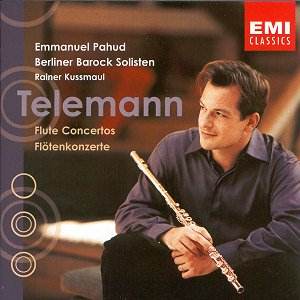
Georg Phillipp TELEMANN (1681-1767)
Concerto for flute in G major TWV 51: G2
Concerto for two flutes, violone, strings and continuo TWV 53:a1 (from Tafelmusik)
Concerto for transverse flute, strings and continuo, TWV 51:D2
Concerto for flute, oboe d’amore, viola d’amore, strings and continuo TWV 53:E1
Concerto for flute, strings and continuo in D, TWV 51:D2
Emmanuel Pahud, flute; Rainer Kussmaul, violin and leader; Georg Faust, cello; Wolfram Christ, viola d’amore; Klaus Stoll, violone; Jacques Zoon, flute; Albrecht Mayer, oboe d’amore.
Berliner Barock Solisten, Rainer Kussmaul, conductor.
Emmanuel Pahud, the Swiss-French flutist, who was, like his illustrious predecessor James Galway, the principal of the Berlin Philharmonic, has in recent years taken off on a spectacular solo career. Unlike his Irish counterpart, Pahud has yet to resort to pop music and gimmicks to sell records, and has released a series of nearly flawless recordings for EMI. I do not know of another classical artist active today whose recordings I will buy on release day, simply because he is on them. Pahud is one of the most solid, artistic and refined musicians in the world, and this splendid collection of concerti by Telemann has risen to the very top of my listening pile in very short order.
Telemann was the most respected composer of his generation. Admired and imitated by such stars as Bach and Handel, Telemann was monumentally prolific, leaving behind hundreds of cantatas, chamber works, keyboard and orchestral pieces. The highlight of this recital is the recently reconstructed concerto in G major TWV 51:G2. Through the painstaking work of Arn Aske and Ulrike Feld, a gem has been restored to the repertoire. Until 2000 this piece was thought unplayable as the manuscript, housed in the library at Rostock was all but unreadable. Acidic ink had eaten holes in the paper, obliterating notes and the ink had bled through pages upon which both sides of the paper were written. Further, there were huge portions of score missing where the pages were torn completely away. Through great effort and research into Telemann’s style in 1721 when this piece was composed, Aske and Feld were able to reconstruct the concerto enabling us to enjoy this lovely work again.
To my ears, there is not a flaw to be found in this recording. Telemann of course, was a master orchestrator and his writing for the soloists is perfectly idiomatic. The balance between the soloists and orchestra is excellent. The Berliner Barock Solisten is as tight an ensemble as I have ever heard. Intonation is perfect, balances right on and they have a wonderful sense of the elegance of this music. Soloists in addition to Pahud play beautifully and in the double and triple concertos there is a delightful sense of collegial give and take. Albrecht Mayer’s oboe d’amore sings with splendid contralto warmth in the E major concerto TWV 53:E1.
Recorded sound is right on the mark here, with excellent balance, lovely ambience and warmth. No flaws in the programme booklet either, with fascinating and informative notes by Ulrike Feld, complete biographies of the artist, and even a personnel list of the orchestra with details about their instruments. An absolute winner, this disc is not to be missed.
Enlaces:
02 noviembre 2011
Jarrell - ... prisme / incidences... - E. Pahud


...prisme / incidences... (1998)
The notion of prism applied to a whole instrumental ensemble, which Jarrell makes explicit in the title of his work, condenses and crystallises the hidden side of the solo violin. "I frequently like to use an extra-musical concept," Jarrell points out, "whether from the visuel or literary sphere." It was with the fullness of drawing that an artist such as Giacometti sought "this incredible means [...] of seeing clearly like no one else." Similarly, it is again with the fullness of the melodic pattern that Jarrell seeks contradictory or complementary angulations, the moment when the instrumental ensemble falls back on the violin, for example, like a facetted crystal, a prism that transforms the score into an object. As for the notion of incidence, it must be understood in the architectonic sense of the term. With Jarrell, there is a dialectical desire that consists of working sound masses by line and inversely so that the instrumental ensemble refracts the attributions of the solo violin, creating singular, independent volumes. One of the decisive effects of incidence lies in the transformation of instrumental colour by instrumental colour. The magical paradox of the prism: in splitting up the sounds of the violin, by distributing them in "crystal" fashion, Jarrell manages to modify the recognisable quality of the instrumental attacks. More than complex interpolations of timbres, it is a matter of acoustic "beams", rendering a homogeneous perception of sonority null and void, whereas the work's formal development meets a transparent norm. The plurality of incidence or incidences answers the singularity of the prism. The shock provoked by the refracted wave is limitless or, at least, the limits of notation, which, with Jarrell, often looks infinitesimal and does not imply a limited promulgation of colours and volumes. Here, the rhetoric of the concerto reaches a threshold of its own destabilisation or even dissolution. The prism infers the incidences as form and no longer only as grammar.
Sillages (2008)
Sillage (Wakes): "the trace that a ship leaves behind it on the surface of waters," says the dictionary. But also: "Part of a fluid (liquid, air) left behind a body in motion - perturbations that occur therein." As a child, Michael Jarrell was as keen on drawing as he was on music. and although the latter eventually won out, visuel, graphie or geometric inspiration have never completely left the Geneva-born composer. In his sound universe, sillages become undulations, waves, backwash or eddies whilst also suggesting the idea of passage or widening. Moreover, he uses an image far removed from the dryness of a dictionary definition: that of a "quill pen drawing a line on a blotter". The ink then takes on a lite of its own as it impregnates the paper unevenly. "With me, titles serve as a clue, a track for grasping the poetic idea of a work." As will have been understood, Michael Jarrell's plural Sillages open up a wide range of meanings, expressing the composer's concerns, whether musical, formal or simply human. With the first sillage, ita eddies indicate a continuity in the composer's catalogue. This creation also marks the complicity that links him to clarinettist Paul Meyer, to whom Jarrell has already dedicated a concerto. "Through Paul, I got to know the flautist Emmanuel Pahud, then the oboist François Leleux... I greatly appreciate this young generatlon of musicians, capable of playing the classics perfectly as well as remaining attuned to their era." Second sillage: affective. As for the third, it can be heard in the work's very matter, right from the outset. Flute, oboe and clarinet play an A, the same note that musicians use for tuning up before a concert. Two notes follow this A, then others, taken up by the orchestra. which acts as a sort of reflection or distorting mirror. The sound field broadens, and these figures, born from the breath of the wind soloists, take on their own life in the symphonic ensemble surrounding them. We again find this idea throughout the piece, particularly in a great oboe solo two-thirds of the way through the score. "I like to write within more or less rigid rules and fetters, always with the aim of channelling energy and expression," Michael Jarrell points out. "Like a stream with numerous twists but which would never overflow its banks."
Trois Etudes de Debussy (1992)
The harmonic language of Michael Jarrell's works is marked by a subtle sounding out of intervallic relationships: chords derive their characteristics from the specific arrangement of their intervals. Among the most important historical forerunners of compositions exploiting intervallic relationships are the late piano works of Claude Debussy. In his Douze Etudes for piano (1915), Debussy frees himself from tonal relations by concentrating the examination of individual intervals.
Jarrell scored three of the twelve etudes for a fairly small orchestra, avoiding instruments which would not have been available to Debussy himself. In his orchestration of the etudes Pour les notes répétées, Pour les sonorités opposées and Pour les accords, his aim was to prolong the style of Debussy's somewhat austere late orchestral music with the greatest possible authenticity. Jarrell treated Debussy's etudes as previously existing materiel.
Jarrell sees his compositional output as constituting an arborescent system in which similar forms can blossom in various fashions on different branches. This results in unusually close interconnections between his works - and even between his original compositions and his orchestrations. For, in fact, the titles of the three etudes (which are Debussy's) can be read as summing up three central creative resources of Jarrell's own musical language: repeated notes, contrasted timbres, and chords. Although it is probably no more than chance, this coincidence nevertheless fits neatly and naturally into the overall picture of an oeuvre which is determined by richly interrelated ramifications: "I believe in a network in the mind."
Abschied (2001)
The piano concerto Abschied was a commission of the Salzburg Festival and had its premiere there on the 8th of august 2001. The initial idea was that of a spiral developing almost infinitely. A chain of notes, beginning in the highest register, undergoes a constant filtering process to reach a momentarily stable form before undergoing a new filtering process. These mutations occur rapidly and have direct consequences on the music which is fast and of an energetic virtuosity. This is net only limited to the soloist but spreads also to the orchestra. This "playful" section was nearly finished when my father died. This event had a decisive influence on the score. The swirling energies deployed in the upper register change direction. The piece slows down, seeking the depths, acting more with resonances, turns into a music that disappears, that "bids farewell". The initial narration is interrupted and opens up to areas of reflection, silence and memory.
Enlaces:
Paris - E. Pahud & E. La Sage


Sonata para flauta y piano (Poulenc)
La Sonata para flauta y piano del compositor francés Francis Poulenc fue escrita en 1957. Está dedicada a la memoria de Elizabeth Sprague Coolidge, una mecenas estadounidense de música de cámara. Poulenc la compuso para el flautista Jean-Pierre Rampal y él mismo y Rampal ofrecieron el estreno de la obra en junio de 1957 en el Festival de Estrasburgo. Hoy en día es una de las obras más conocidas de Poulenc y forma una parte importante del repertorio para flauta del Siglo XX.
Historia
Poulenc tuvo la idea de componer una sonata para flauta durante mucho tiempo, que se remanta hasta el año 1952 en una carta al baritono Pierre Bernac. Los años siguientes, Poulenc quiso reanudar el trabajo según mencionaba en sus cartas a su editor en 1953, 1955 y 1956.
Sin embargo se desconoce si la sonata planeada está relacionada con la sonata que finalmente se publicó. En abril de 1956, Harold Spivacke, el portavoz de la Fundación Coolidge de la Biblioteca del Congreso, escribió una carta a Poulenc para encargarle una pieza de música de cámara para una festival que tendría lugar en octubre de 1956. Poulenc rechazó el encargo dado que estaba acabando la orquestación de su ópera y el estreno en Milán estaba cercano. Spivacke de nuevo le ofreció el encargo en mayo y esta vez Poulenc le contestó en agosto que podría escribir algo para él dado que la ópera ya estaba lista. Él sugirió una sonata para flauta y piano, con la condición de que fuera interpretada por primera vez durante el Festival de Estrasburgo en junio de 1957.
Jean-Pierre Rampal se enteró de la sonata en una llamada de Poulenc. La ocasión se menciona en su autobiografía:
«Jean-Pierre,» dijo Poulenc: «¿no es verdad que siempre has querido que escribiera una sonata para flauta y piano? Bien, voy a hacerlo. ¡Y lo mejor de todo es que los estadounidenses van a pagar por ello! Me han encargado desde la Fundación Coolidge que escribiera una pieza de música de cámara en memoria de Elizabeth Coolidge. Yo nunca la conocí, así que pienso que la pieza es tuya».
Poulenc escribió la pieza en Cannes entre diciembre de 1956 y marzo de 1957 y el manuscrito completo fue enviado a la Biblioteca del Congreso el 7 de junio de 1957. El 17 de junio de 1957, tuvo lugar un estreno no oficial en el Festival de Estrasburgo por el compositor y Rampal - con tan sólo un espectador, Arthur Rubinstein, que solicitó escucharla un día antes del estreno oficial dado que tenía que marcharse.
El 16 de enero de 1958, Poulenc tocó la obra con Gareth Morris en una emisión de la BBC. El estreno tuvo lugar en al auditorio Coolidge de la Biblioteca del Congreso el 14 de febrero de 1959. Se sabe que fue un gran éxito.
Sonatina para flauta (Dutilleux)
La Sonatina para flauta (1943) muestra las influencias, patentes en sus primeras obras, de Ravel, Debussy y Roussel, como él mismo confesará más adelante mostrando sus reservas por un lenguaje poco personal. En ese mismo año 1943, comienza a trabajar para Radio France. Al año siguiente compusó la La Gêole, para voces y orquesta (1944), de nuevo con otro poema de Cassou, un soneto de los Trente-Trois Sonnets composées au secret (1943), una obra compuesta mientras estaba encarcelado, a veces sin papel, de memoria, que fue publicada de modo clandestino por las «Editions de Minuit».
Pierre Sancan
( b Mazamet , 24 Oct 1916). Pianista y compositor francés. Tras sus estudios iniciales de piano en Marruecos y Toulouse, se mudó a París y estudió con Yves Nat en el Conservatorio donde recibió el primer premio en 1937. Posteriormente obtuvo primeros premios en harmonía, fuga, acompañamiento y composición, y estudió dirección con Charles Münch y Roger Désormière. En 1943 fue galardonado con el Premio de Roma, y durante un tiempo fue igualmente compositor y músico. Solista internacional y músico de cámara, Sancan fue también profesor de piano en el Conservatorio de París (1956–85), donde se convirtió en uno de los principales profesores; entre sus alumnos estaban Michel Béroff, Jean-Philippe Collard, Jean-Bernard Pommier y Jacques Rouvier. Sus obras incluyen brillantes fragmentos de los dos conciertos de Ravel, dirigidos por Dervaux, y las 5 sonatas para chelo y piano de Beethoven, con André Navarra. Las obras de Sancan, muchas de ellas publicadas, incluyen una opera Ondine (1962) y dos ballets, una sinfonía para cuerda, dos conciertos de piano (1955, 1963), música de cámara, canciones y piezas de piano.
Jaques Ibert
Jacques François Antoine Ibert (15 de agosto de 1890 - 5 de febrero de 1962) fue un compositor francés de música clásica.
Estudió con Paul Vidal en el Conservatorio de París y ganó el Premio de Roma en 1919 con su cantata Le poète et el fée. A partir de 1937 que fue director de la Academia Francesa en Roma, y entre 1955 y 1957 dirigió la Opéra-Comique de París. Murió en París.
La música de Ibert se considera ser típicamente muy "ligera" de carácter, a menudo ingeniosa, orquestada coloridamente con melodías atractivas. Aunque no era un miembro de Les Six, su música comparte algunas características con las de los miembros del grupo. Su obra más conocida posiblemente sea su Divertissement para orquesta (1930), basado en su música incidental para la obra de Eugène Labiche, Un Chapeau de paille d'Italie (El sombrero de paja italiano). En el curso de la obra él cita cómicamente muchas obras, incluyendo la Marcha nupcial de Felix Mendelssohn. Otros obras prominentes son Escales (1924) para orquesta, el poema sinfónico La Ballade de la geôle de Reading (basada en el poema de Oscar Wilde), su Concierto para flauta y el Concertino da Camera (1935) para saxofón y Le petit âne blanc para piano solo. Compuso varias óperas, tales como L'Aiglon, y la opereta Les Petites Cardinal, en parte hecha por Arthur Honegger. Entre su música para películas está aquélla para la película de Orson Welles sobre Macbeth (1948).
Le merle Noir (Messiaen)
"Le merle noir" es una pieza para flauta y piano, escrita por encargo: se le pidió una obra que pudiera ser interpretada por los estudiantes de flauta. En la época, Messiaen estaba profundamente interesado en el canto de los pájaros, y del mismo extrajo inspiración para esta pieza. El "merle noir" no es sino el mirlo común, extendido por vastas regiones de Eurasia. Las notas que en la pieza se le arrancan a la flauta, siguen precisamente las armonías del canto del mirlo.
Tras unos acordes amenazadores del teclado, en apenas seis minutos se suceden una cadencia de la flauta (marcada “un poco vivo, con fantasía”) seguida de un diálogo entre los dos instrumentos (”casi lento, tierno”) introducido por un motivo ensoñador expuesto en el piano y retomado por la flauta. Una segunda cadencia de ésta y un nuevo diálogo preceden a la brillante y jubilosa explosión final en un tiempo muy vivo. Como señala la pianista Yvonne Loriod, viuda del músico y extraordinaria intérprete de su obra, “todas las notas resuenan en el pedal, como piedras de colores que se entrechocan” en esta página compuesta “a la gloria de la fantasía, el virtuosismo y el genio del mirlo negro”.
Chant de Linos (Jolivet)
En la mitología griega Lino fue instructor de música de Heracles, y le enseñó a tocar la lira, pero en una ocasión en que reprendió agriamente a su pupilo, éste perdió los estribos y le golpeó con la lira en la cabeza, matándolo.
Se le considera la personificación de los himnos funerarios mediante la repetición de la palabra: "Ailinon".
Enlaces:
Opium - Melodies Francaises - Philippe Jaroussky (feat. E. Pahud)


Philippe Jaroussky
Philippe Jaroussky es un contratenor, nacido el 13 de febrero de 1978, Maisons-Laffitte, Francia.
Es sopranista y contratenor francés. Estudió violín, piano, armonía y contrapunto en el conservatorio de Versalles. En 1996, comenzó sus estudios de canto con Nicole Fallien y los continuó en el Departamento de Música Antigua del Conservatorio de París con Michel Laplenie, Kenneth Weiss y Sophie Boulin. Recibió su diploma como violinista de la Facultad de Música Antigua del Conservatorio de París.
Philippe Jaroussky actuó por primera vez en 1999 en el Festival de Royaumont. En este mismo año, intervino en el oratorio de Scarlatti Sedecia en los festivales de Royaumont y AMBRONAY con Il Seminario Musicale y Gérard Lesne (CD en Virgin Classics). Con la Grande Ecurie et la chambre du Roy, dirigida por Jean-Claude MALGOIRE, participó en la trilogía de Monteverdi (Orfeo, Il Ritorno di Ulisse y L'Incoronazione di Poppea) y en 2001 cantó el papel de Arbace en Catone in Utica de Antonio Vivaldi , así como el Nisi Dominus del compositor venciano y el Stabat Mater de Giovanni Battista Pergolesi. En 2003, apareció como Nero en el Théâtre des Champs Elysées' en Agrippina Georg Frideric Handel.
Philippe Jaroussky colabora frecuencuentemente con Jean Tubéry y el conjunto La Fenice para los que ha grabado La Morte Delusa de Giovanni Battista Bassani y un Concert chez Mazarin (Virgin Classics). Para el conjunto Matheus, dirigido por Jean-Christophe Spinosi, ha grabado La Verità in Cimento (Opus 111) así como el papel de Ruggiero en el Orlando Furioso en una actuación en el Théâtre des Champs Elysées para el sello Naïve. Con Gabriel Garrido y el Ensemble Elyma ha grabado la L'incoronazione di Poppea y la Selva Morale e Spirituale de Monteverdi.
Se caracteriza por una técnica virtuosista de melisma para animar y obligar a la interpretación de cantatas barrocas y la ópera. Esto ha contribuido a su inusual repertorio de reactivación. Canta bien con violines de Vivaldi (y conjuntos). Recibió en 2007 el premio al mejor artista lírico francés.
Actualmente, la presentación de una serie de recitales con su propio conjunto, Artaserse, ha interpretado a Telémaco en Ulisse con René Jacobs en la Staatsoper de Berlín y a Eustazio de Rinaldo en la Vlaamse Opera dirigido por Andreas Spering.
Fue el primer considerado del disco para el sello Ambroisie con obras de Benedetto Ferrari. Ha recibido la aclamación de críticos, ganando el Diapason Découverte, recommande de Repertorio, Timbre de Platine d'Ópera Internacional, Prix de l'Academie Charles Cros, el Gran Premio del Sindicato de la crítica, etc. Su primer disco, como exclusiva para Virgin Classics, se compone de cantatas para contralto y conjunto de Antonio Vivaldi.
De acuerdo con La Terrasse, "este joven cantante, con el tono de un ángel y el virtuosismo del diablo maldito, ha entrado en el centro de atención en sólo unos pocos años como el nuevo gran talento vocal francés".
Suscribirse a:
Entradas (Atom)


