 Twitter
 Facebook
 Flickr
 RSS

Mostrando entradas con la etiqueta baroque music. Mostrar todas las entradas
Mostrando entradas con la etiqueta baroque music. Mostrar todas las entradas
21 abril 2012
The Stardust Quartet and Christopher Hogwood - Concerti di Flauti


Christopher Jarvis Haley Hogwood, CBE (10 de septiembre de 1941) es un director de orquesta británico y clavicembalista muy conocido.
Christopher Hogwood nació en Nottingham. Estudió música y literatura clásica en el Pembroke College, Cambridge. Estudió ejecución y dirección orquestal con Raymond Leppard y Thurston Dart; después con Rafael Puyana y Gustav Leonhardt. El British Council le permitió estudiar un año en Praga.
En 1967 Hogwood fundó el Early Music Consort of London con David Munrow, y en 1973 fundó la Academy of Ancient Music, especializada en ejecuciones de música barroca y el temprano clasicismo con instrumentos del período. El Early Music Consort se deshizo después del suicidio de Munrow en 1976, pero Hogwood continuó ejecutando y grabando con la Academy of Ancient Music y también como director invitado en muchas otras orquestas.
Desde 1981, Hogwood ha dirigido regularmente en los Estados Unidos. Sirvió como director artístico de la Handel and Haydn Society de Boston entre 1986 y 2001. Desde entonces tiene el título de Director Laureado del mismo grupo. De 1983 a 1985 Hogwood fue el director artístico del Festival Mostly Mozart en el Barbican Centre de Londres. De 1987 a 1992 fue el director musical de la Orquesta de Cámara Saint Paul en Minnesota, que lo nombró su principal director invitado.
Hogwood también dirige habitualmente ópera. Hizo su debut operático en 1983, dirigiendo Don Giovanni en St. Louis, Missouri. Ha trabajado con la Ópera Estatal de Berlín, la Ópera Real de Estocolmo, la Royal Opera House en Covent Garden, Chorégies d'Orange y la Houston Grand Opera. Con la Ópera de Australia, hizo Idomeneo en 1994 y La clemenza di Tito en 1997 Ifigenia en Táuride.
En mayo de 2006 se anunció que Richard Egarr sucedería a Hogwood como Director Musical de la Academy of Ancient Music el 1 de septiembre y que Hogwood asumiría el título de Director Emérito. Hogwood dijo que esperaba dirigir "al menos un proyecto grande" con la Academia cada año.
Si bien Hogwood es mejor conocido en el repertorio barroco y clásico temprano, también ejecuta música contemporánea, con una afinidad particular por las escuelas neo-barrocas y neoclásicas incluyendo muchas obras de Stravinski, Martinu y Hindemith.
Las publicaciones de Hogwood incluyen una investigación del patronazgo a través del tiempo (Music at Court), estudios biográficos de Haydn, Mozart y Handel, una historia de la trío sonata, e investigaciones sobre música británica incluyendo un libro sobre la Música Acuática de Handel y la Música para los Reales Fuegos Artificiales.
Desde 1992 ha sido profesor internacional de Ejecución de Música Antigua en la Royal Academy of Music, y como profesor visitante del King's College de Londres. Sus puestos académicos también incluyen ser Profesor Honorario de Música de la Universidad de Cambridge y Fellowships en el Jesus College y Pembroke College (Cambridge).
The Amsterdam Loeki Stardust Quartet is a professional Dutch recorder quartet which was founded in 1978 by four students of the Sweelinck Conservatory Amsterdam; Daniël Brüggen, Bertho Driever, Paul Leenhouts and Karel van Steenhoven. Following its formation, the ensemble's reputation grew quickly and was further strengthened at the 1981 Musica Antigua Competition in Bruges where, challenging the competition rules, it performed an unusual arrangement of a Stevie Wonder song and emerged as the winner.
During the last 30 years, the Amsterdam Loeki Stardust Quartet has enjoyed an international career and are recognized as a serious ensemble of unparalleled virtuosity. They have appeared together at many early music festivals including those in Berlin, Utrecht, London and Sapporo, and regularly tour throughout Europe, the USA and Japan. They also perform separate from festivals in concert halls. In 1998, 2001, 2004,2009, Queen Beatrix of the Netherlands requested the quartet to perform for her during official festivities. Since its formation, the quartet has continually explored the boundaries of the recorder consort, playing a mix of recorder music from all ages of music, especially from the Renaissance, Baroque and twentieth-century. A number of composers have been inspired to write for the Quartet, which has helped create a new repertoire that proves the recorder to be an important voice of our time.
A few years ago, both Bertho Driever and Paul Leenhouts left Loeki Stardust in order to pursue another career in music. They were replaced by Daniel Koschitzki and Andrea Ritter. After internal struggle, it was decided to end the ensemble which lead to a farewell concert in November 2007. After seeing each other in private, the four founding members of the group decided to regroup in order to celebrate their 30th anniversary in 2008, but not to make plans after that since they do not wish to re-establish an ensemble. At present, about 50 concerts are planned all over the world.
A few years ago, both Bertho Driever and Paul Leenhouts left Loeki Stardust in order to pursue another career in music. They were replaced by Daniel Koschitzki and Andrea Ritter. After internal struggle, it was decided to end the ensemble which lead to a farewell concert in November 2007. After seeing each other in private, the four founding members of the group decided to regroup in order to celebrate their 30th anniversary in 2008, but not to make plans after that since they do not wish to re-establish an ensemble. At present, about 50 concerts are planned all over the world.

26 diciembre 2011

25 diciembre 2011
Telemann, Heinichen, Marcello - Concerti di flauti - Amsterdam Loeki Stardust Quartet


Since its formation the Amsterdam Loeki Stardust Quartet has explored the boundaries of the recorder consort. Its musical adventure started in 1978 when studying at the Sweelinck conservatory in Amsterdam and discovering the quartet as a new phenomenon. The ensemble's reputation grew quickly when they emerged as the winner of the 1981 Musica Antigua Competition in Bruges despite testing the competition rules by performing an unusual arrangement of a Stevie Wonder song.
What followed was the recognition as a serious ensemble of unparalleled virtuosity, a recording contract with Decca and the start of an international career. Both their playing style and choice of repertoire, something unheard of at the time, made them appear at many festivals and they toured throughout Europe the United States, South America and Japan.
Their unusual name refers to a melody played on their very first rehearsal. It expresses affection for unusual repertoire in addition to the classic consort music of the Renaissance and Baroque periods. A number of composers have been inspired to write for the Quartet, which has helped create a new repertoire that proves the instrument to be an important voice of our time. Graham Fitkin, Tristan Keuris, Chiel Meijering, Peter Jan Wagemans, Philip Wharton en Lera Auerbach are amongst the many composers who wrote for the quartet.
The Quartet also contributes to the expansion of the recorder repertoire by publishing a series of new recorder music and through the collaboration with recorder makers. The Boston based instrument maker Friedrich von Huene designed a fully keyed bass and contrabass recorder allowing the group amongst others to perform and record Bach’s Art of Fugue. The group has assembled a unique collection of over a hundred Renaissance, Baroque and modern recorders, ranging from an 8-inch sopranino to a sub-contrabass measuring over nine feet. The quartet’s recordings (for L'Oiseau-Lyre, Decca and Channel Classics) have confirmed its reputation as the world's most innovative and exciting recorder consort.
24 diciembre 2011
J. S. Bach - Complete Flute Sonatas vol. 1 & 2 - K. Kaiser


Karl Kaiser studied at the Colleges of Music in Cologne and Münster. Parallel to this he also studied theology, philosophy and musicology at the universities in Bonn and Cologne, ultimately deciding on a musical profession. Since then he has made an excellent name for himself as a soloist, chamber and orchestral musician in the area of historically informed performance techniques.
After gaining wide-ranging and inspiring experience in the most varied of orchestras and groups for historical music, Karl Kaiser now concentrates on a few complementary ensembles. He has been a flautist at the Camerata Cologne for almost 30 years, with worldwide concerts and more than 50 CDs covering a large part of the Baroque and early classical chamber music.
He has been a member and flautist of the Freiburg Baroque Orchestra for many years and is constantly underway worldwide with this ensemble as an orchestral musician and soloist. Karl Kaiser is also a founding member and flautist of the La Stagione orchestra in Frankfurt under Michael Schneider. Karl Kaiser plays early Romantic chamber music with Petra Müllejans (violin) and Sonja Prunnbauer (guitar) on original instruments in the trio Sérénade à Trois.
Karl Kaiser is an enthusiastic and all-embracing teacher. He is Professor for Historical Flutes and Performance Techniques at the College of Music and Performing Arts in Frankfurt and at the College of Music in Freiburg. He regularly gives master courses and holds presentations on performance techniques of the 18th century. He has published articles in newspapers and a book of his, Fundamental Knowledge of Baroque Music was published by the con brio Verlag. Karl Kaiser sees his teaching activities as being within a higher-ranking framework – beyond the pure communication of skills.
08 diciembre 2011


Locatelli - Flute Sonatas - J. Wentz


Jed Wentz began his flute studies with Walter Mayhall in Youngstown, Ohio, and continued studying with James Walker in Pittsburgh, Pennsylvania. He studied modern and historical flutes at the Oberlin Conservatory of Music with Robert Willoughby and Michael Lynn, and received a Soloist's Diploma from the Royal Conservatory in The Hague after three years with Barthold Kuijken. He has performed and recorded with groups such as Musica Antiqua Koln, Les Musiciens du Louvre, Capriccio Stravagante Paris and the Gabrielli Consort. In 1992 he founded Musica ad Rhenum, with whom he has recorded more than 20 CDs both as flutist and conductor. His recording of the complete flute sonatas of Locatelli was awarded the prize for the Best Recording of Italian Music 1995 by the Fondazione Cini Venetia. Mr. Wentz teaches at the Amsterdam Conservatory of Music, and lectures regularly on performance practice at the Royal Academy of Music in London. He has published articles in Early Music, Concerto, and Tijdschrijft voor Oude Muziek. He is pursuing his doctorate through Leiden University, with his research centering on the relationship between 18th-century staging and tempo in the tragedie en musique.
LINKS:


02 diciembre 2011


23 noviembre 2011


22 noviembre 2011
Italian Flute Concertos - J. P. Rampal


Jean-Pierre Rampal (n. 7 de enero de 1922, Marsella - † 20 de mayo de 2000) fue un flautista francés y ha sido reconocido por devolver a la flauta su popularidad como instrumento clásico solista, popularidad que no tenía desde el siglo XVIII.
Biografía
Rampal nació en Marsella, donde su padre, Joseph Rampal, era primer flautista en la sinfónica y profesor en el conservatorio. Aunque no tenía la motivación para llegar a ser músico profesional, su padre le enseñó desde que el joven Jean-Pierre tenía 12 años. A los 16 obtuvo su primer premio como flautista, en el mismo año que dio su primer recital público.
No sería hasta mucho después que Rampal, una vez comenzados estudios de medicina, decidió seguir la carrera artística. En su tercer año en la escuela de medicina, las fuerzas de ocupación nazi le enviaron a realizar trabajos obligatorios a Alemania, pero en vez de reportarse al servicio, pasó a la clandestinidad y se dirigió a París. Allí decidió seguir cursos en el Conservatorio Nacional y cinco meses después se graduó con el primer lugar de la competición anual de flautistas, premio que Joseph, su padre, ya había ganado antes en 1919.
En 1945, Rampal fue invitado a tocar un concierto de flauta junto con la Ópera de París, de esta forma adquirió cierta fama y experiencia. Durante los diez años siguientes Rampal se dedicó a ser intérprete solista, y, con la guerra terminada, se decidió dar una serie de conciertos empezando en Francia pero después, en 1947 trasladándose a Suiza, Austria, Italia, España y los Países Bajos junto con su compañero pianista Robert Veyron-Lacroix a quien había conocido en 1946.
En 1955 se convierte en primer flautista de la Opéra de París y luego desarrolla sus actividades como solista o músico de cámara. Fundó el Conjunto Barroco de París y el Quinteto de Vientos Francés. A principios de los 60's Rampal era considerado el más virtuoso flautista internacional, pues trabajó con las mejores orquestas del mundo en ese tiempo, pero siguió reviviendo la música, sobre todo barroca, como había hecho desde 1945. Durante los 60's y hasta finales de los 80's tuvo mucha fama, sobre todo en América y Japón. Durante la década de los 60's fue inclusive cosiderado el príncipe de los flautistas
En 1969 fue nombrado profesor del Conservatorio de París y durante los veranos ofreció cursos en la Academia Internacional de Niza. Colaboró con otros artistas como Isaac Stern, Yehudi Menuhin y Mstislav Rostropóvich y dirigió algunas orquestas.
En 1978 gana el premio Sonning Award en Dinamarca. A partir de 1980 se abrió el Concurso de Flauta Jean-Pierre Rampal, que desde ese año se efectúa premiando a los mejores flautistas del mundo.
Rampal fue un promotor incansable del repertorio para flauta, sobre todo aquel del barroco y del clasicismo. Gracias a su labor, la flauta recupera un sitial en el circuito de conciertos al mismo nivel que el piano o el violín. Grabó prácticamente todas las obras importantes para el instrumento, llegando a sumar más de 50 discos. También abordó arreglos y transcripciones. Además incursionó en el jazz, el folclore, la música popular y la música oriental. Hubo varios compositores que le dedicaron partituras, entre otros Jolivet, Francaix, Martinon, Poulenc y Boulez, y a comienzos de los 90 estrenó el Concierto para flauta de Krzysztof Penderecki.
De esa manera en 1998 y 1999 dio sus últimos conciertos, un magno concierto en el llamado Teatro de los Campos Elíseos en París. Su última grabación en 1999 fue de tríos y cuartetos con el trío Pasquier y con su discípulo predilecto el flautista catalán Claudi Arimany, continuador de su legado musical.
En mayo de 2000, Jean-Pierre Rampal muere de un problema cardíaco a los 78 años.
En el 2005 fue creada la Asociación Jean-Pierre Rampal para continuar el estudio de la flauta solista y como apreciación a la contribución de Rampal a la interpretación de este instrumento.
15 noviembre 2011
Vivaldi - Complete Flute Concertos - Severino Gazzelloni


Severino Gazzelloni (Roccasecca -Frosinone-, 5 de enero de 1919 - Cassino, 21 de noviembre de 1992) fue un flautista italiano, uno de los mayores virtuosos del siglo XX. Durante treinta años fue el primer flauta de la Orquesta de la RAI y muchos compositores contemporáneos le dedicaron obras, escritas especialmente para él (entre otros, Luciano Berio, Pierre Boulez, Bruno Maderna e Ígor Stravinsky).
Gazzelloni fue también un gran profesor. Entre sus alumnos se encuentran el intérprete de jazz Eric Dolphy y el flautista clásico Abbie de Quant. Gazzelloni participó activamente en los Cursos de Verano de Darmstadt.
J. S. Bach - Flute Concertos - M. Gatti

After his two recent incursions into the musical world of the young vivaldi, that excellent violinist from italy enrico gatti, together with his ensemble aurora, has a further pleasant surprise for us: on this occasion it is a hitherto unpublished work by johann sebastian bach. using as a basis a series of arguments of an unquestionable solidity - set out in a fascinating booklet article accompanying our disc - the musicologist francesco zimei has reconstructed the until now lost flute concerto in b minor. the inclusion of this work in the neue bach ausgabe is currently being arranged. zimei's meticulous and detailed study has as its starting point bach's habit of reusing instrumental works for new vocal compositions. in this way, zimei identifies as sources for the "new" concerto the aria zieht euren fuß nur nicht zurücke (bwv 207/3), the introductory sinfonia from the cantata non sa che sia dolore (bwv 209) and an aria included in the celebratory cantata durchlauchtster leopold (bvw 173a). once the magnificent results have been heard few doubts can remain that we have here a new treasure by the kantor of the thomasschule. the brothers gatti - marcello is the flautist on this disc - complete their bach recital with the earlier version of the fifth brandenburg concerto (the "triple concerto" in d major, bwv 1050a) and with the famous ouverture in b minor (bwv 1067), works closely related both in contents and their galant-style intentions with the new discovery which has motivated this recording. this new discovery will undoubtedly provide much scope for discussion and will serve as encouragement for the inclusion of a new work in the repertory for many ensembles.
Biografy

Born in Perugia (Italy) in 1967, Marcello Gatti graduated at the Conservatory “F. Morlacchi” on modern flute in 1986.
Ensemble Aurora (Enrico Gatti),
Accademia Bizantina (Ottavio Dantone),
Zefiro (Alfredo Bernardini),
Cappella della Pietà de’ Turchini (Antonio Florio),
Attaignant Consort (Kate Clark),
Armonico Tributo Austria (Lorenz Duftschmidt),
Cantus Cölln (Conrad Jungaenel),
Le Concert de Nations (Jordi Savall),
Amsterdam Baroque Orchestra (Ton Koopmann),
Accademia Montis Regalis (Alessandro De Marchi),
Piccolo Concerto Wien.
He is leaving in Cremona since 1998.
He teaches renaissance, baroque and classical flute in the Conservatorio Statale "F.E.dall'Abaco" di Verona, in the "Civica Scuola di Musica" di Milano,in the Hochschule fuer Musik und Teather "Felix Mendelssohn Bartholdy"(Leipzig-Germany) and in the and in various international summer courses like in the Urbino early music festival.
14 noviembre 2011
Telemann - 12 Fantasies for Solo Flute - P. Gallois


Georg Philipp Telemann's 12 Fantasias for Solo Flute were published in Hamburg in 1732–33. This is one of Telemann's collections of music for unaccompanied instruments, the others being thirty-six fantasias for solo harpsichord published in Hamburg in 1732–33, twelve for solo violin published in 1735, and a set of twelve fantasias for solo viola da gamba, published in the same year, but that is currently lost.
This work comprises the following:
Fantasia in A major (Vivace—Allegro)
Fantasia in A minor (Grave—Vivace—Adagio—Allegro)
Fantasia in B minor (Largo—Vivace—Largo—Vivace—Allegro)
Fantasia in B-flat major (Andante—Allegro—Presto)
Fantasia in C major (Presto—Largo—Presto—Dolce—Allegro—Allegro)
Fantasia in D minor (Dolce—Allegro—Spirituoso)
Fantasia in D major (Alla francese—Presto)
Fantasia in E minor (Largo—Spirituoso—Allegro)
Fantasia in E major (Affettuoso—Allegro—Grave—Vivace)
Fantasia in F-sharp minor (A Tempo giusto—Presto—Moderato)
Fantasia in G major (Allegro—Adagio—Vivace—Allegro)
Fantasia in G minor (Grave—Allegro—Allegro—Dolce—Allegro—Presto)
The collection is arranged by key, progressing more or less stepwise from A major to G minor. Telemann deliberately avoided keys that are impractical on the one-key flute, i.e. B major, C minor, F minor and F-sharp major. There are two ways to view the overall structure of the collection: one way, in which the work is divided into two parts, is suggested by the fact that Fantasia 7 begins with a French overture, indicating a start of a new section. This device was also later used by Johann Sebastian Bach in Variation 16 of his Goldberg Variations. Another was proposed by scholar Wolfgang Hirschmann—there are four modal groups of three fantasias: major-minor-minor, major-major-minor, major-minor-major, and minor-major-minor.
Telemann's solo flute fantasias are alone in the entire Baroque repertoire to include movements seemingly impossible on flute: fugues (fantasias 2, 6, and 8–11), a French overture (fantasia 7) and a passacaglia (fantasia 5).
10 noviembre 2011
Quantz - Flute Concertos - R. Brown


Best known for her moving and virtuosic performances on a huge range of flutes and recorders, Rachel Brown is an acknowledged authority on historical performance practice, an inspirational teacher and an entertaining and illuminating speaker.
Whilst training on modern flute at Manchester University and the Royal Northern College of Music with Trevor Wye she won numerous prizes leading to performances of flute concertos by Ibert and Nielsen and went on to win the coveted American National Flute Association’s Young Artist Competition. She gave first performances of works by Robin Walker, John Ogden, Judith Weir and, for the Park Lane Group, Barry Guy. However, her interest in early music had already been captured by her recorder teacher, Ross Winters, naturally leading to study of the baroque flute with Lisa Beznosiuk and Stephen Preston and an exploration of the many diverse classical and nineteenth-century flutes.
Rachel’s recital discs of French Baroque Music and Quantz Sonatas (for Chandos) established her reputation and her recording of virtuosic works by Schubert and Boehm on simple-system, ring-keyed and Boehm alto flutes has been described as ‘a revelation’. As a soloist she has recorded extensively and toured in Europe, Japan and North America with a comprehensive concerto repertoire from J.S. Bach, Vivaldi and Telemann to Mozart. She has given many performances of the newly discovered Handel Flute Concerto and her championing of the works of the Berlin School has reawakened interest in the largely unknown masterpieces by Quantz. Her dazzling recordings of the Quantz and C.P.E. Bach Concertos (for Hyperion) have won international acclaim. Rachel appears on many Telemann discs with Collegium Musicum 90 (Chandos) and her recording of the complete Handel flute and recorder sonatas op.1 with the Academy of Ancient Music (for Harmonia Mundi) has been described as “enchanting”. She is a founder member and soloist with the London Handel Players with whom she has recorded three discs of Handel’s chamber music (for Somm), described as ‘perfection itself’. Rachel launched her own label, Uppernote, with a tour de force recording of the complete Telemann Fantasias followed by another new disc of virtuosic Quantz Sonatas, entitled Private Passion.
Equally at home in the wind section, Rachel has had a long and distinguished career as an orchestral player; first, on silver flute, with the orchestra of Kent Opera and for many years as principal flute with the Academy of Ancient Music, the Hanover Band, the Kings Consort, Collegium Musicum 90, Ex Cathedra and the Brandenburg Consort. An occasional guest principal with the Orchestra of the Age of Enlightenment, the English Concert, the erstwhile London Classical Players and orchestras abroad such as the Nederlands Bach Vereniging, the Orchestra of the Eighteenth Century and Tafelmusik, Rachel has also appeared as soloist with Arte dei Suonatori in Poland, the Haydn Akademie in Austria and Concerto Copenhagen in Denmark and Germany.
A dedicated teacher, Rachel has given masterclasses in the USA, Canada, Sweden, Poland, Spain, Ireland, Holland, Switzerland, France, Belgium, Croatia, Brazil and New Zealand. She taught for many years at the Royal Northern College of Music, followed by time at the Royal Scottish Academy of Music and Drama, the Birmingham Conservatoire and as lecturer in classical studies at the Guildhall School. She is currently professor of baroque flute at the Royal College of Music. Always enjoying working with children, Rachel has taught recorder at Wells Cathedral School and currently teaches flute and recorder at City of London School. She also runs her own music group for pre-school children.
Rachel is author of the Cambridge University Press handbook to The Early Flute and has composed cadenzas for the new Bärenreiter edition of the Mozart Flute Concertos. Following great interest in her research, Rachel has published two volumes of her favourite Quantz sonatas, supported by subscribers worldwide.
08 noviembre 2011
Johannes Mattheson - 12 Sonatas for flute, violin & continuo

Diana Baroni (transverse flute), Pablo Valetti (violin), Petr Skalka (cello), Dirk Börner (harpsichord)
Diana Baroni, flautista distinguida
Rosarina Perfeccionada en Basilea y Amsterdam, hoy inicia sus actividades en Avellaneda.
Nacida en Rosario, perfeccionada en la Schola Cantorum de Basilea y en el Conservatorio de Amsterdam, radicada actualmente en la ciudad francesa de Lyon, Diana Baroni es una de las flautistas más distinguidas en el campo de la música antigua en toda Europa y acaba de volver a la Argentina para una serie de actividades con el clavecinista Dirk Börner, otro músico excepcional con el que Baroni ha grabado el ciclo de doce sonatas de Johannes Mattheson titulado Der Brauchbare Virtuoso .
Börner vive también en Lyon (enseña bajo continuo en el conservatorio) y tiene una especial afinidad artística con Baroni. “Es uno de los pocos músicos que conozco -dice la flautista- con el que podés estar trabajando horas y horas sin un propósito definido o sin un concierto por delante. Es un tipo muy especial; un yogui que ha estado muchas veces en la India y que admite que podría dejar la música por algo humanitario. Entonces yo le propuse: ‘¿Querés hacer algo humanitario? Vayamos a la Argentina, donde no vamos a ver un peso’. Y así fue -agrega Baroni-: conseguimos un auspicio de Spedidam (una asociación francesa por los derechos del intérprete) que nos permitió pagar los pasajes, y un alumno me ayudó a organizar una serie de conciertos y clases magistrales.” Las actividades comenzarán hoy por la tarde en el Instituto Municipal de Música de Avellaneda, con una clase y un concierto de cierre (a las 20), y terminarán el domingo 12 a las 20.30 en La Manzana de las Luces con un programa dedicado a Mattheson (además de lo que se informa por separado).
Por lo general, los programas alternarán obras de Bach y Mattheson. “Son dos contemporáneos -explica Baroni-, alemanes protestantes y completamente distintos. En cierta forma todavía tenemos un conflicto, ya que las obras de Bach, sobre todo la Partita y la Suite en si menorque también grabamos en un disco, en el fondo son muy intelectuales. La escritura es tan compleja y polifónica, que no te podés distender y entregar a una cosa más sensual. En cambio Mattheson, un protestante extremo, además de esgrimista, matemático, y cuya música tiene toda una numerología muy fuerte, es muy sensual. Es una locura, un contraste inesperado, pero los organizadores dicen que funciona bien, que es un contraste interesante”.
Además de flautista barroca, Diana Baroni es cantante de folclore latinoamericano. Sus primeros discos, con el Diana Baroni trío, estuvieron dedicados a la música peruana; el último lo define como “menos geográfico y más narrativo.
Flor de verano es un día en cuatro capítulos: la mañana, la siesta, la tarde y la noche, con canciones de México, Perú, Ecuador y Venezuela que describen cada momento del día.” Diana Baroni volverá aquí en 2011, pero esa vez con su prestigioso grupo Café Zimmermann para el ciclo de Festivales. No traerán música de Bach (autor con que el grupo está identificado), sino unas cantatas cómicas de barrocos ignotos que interpretará el célebre contratenor Dominique Visse.
(Tomado del diario argentino "Clarín", fecha 03.09.2010)
Scheibe · Agrell & Hasse · Flute Concertos

Maria Bania · Irene Spranger (baroque Flutes)
Concerto Copenhagen
Andrew Manze
Johan Joachim Agrell (1701-1765) · Concerto for Flute, Strings and Basso continuo in D major
Johann Adolph Scheibe (1708-1776) · Concerto for Flute, Strings and Basso continuo in A major
Concerto for Flute, Strings and Basso continuo in D major
Johann Adolph Hasse (1699-1783) · Concerto for Flute, Strings and Basso continuo in G major
Concerto Copenhagen is Scandinavia’s leading period instrument ensemble. Also known as "CoCo", the ensemble has since its establishment in 1991 become known for its lively and captivating performances and has become a favorite among audiences wherever it goes.
In 1999 the internationally acclaimed harpsichord player Lars Ulrik Mortensen became the ensemble’s artistic director. Mortensen is considered to be one of the leading harpsichordists and chamber musicians of our day.
With Lars Ulrik Mortensen as principal leader and artistic director, CoCo has embarked on an exciting artistic and musical journey, combining lesser-known repertoire of Scandinavian origin with the repertoire of the baroque and classical legacy, thus adding a fresh and Nordic flavor to the traditional concert repertoire.
Over the years Concerto Copenhagen has performed and collaborated with a number of the most important figures in early music, including Anne Sofie von Otter, Emma Kirkby, Andreas Scholl, Andrew Manze, Andrew Lawrence-King, Reinhard Goebel and others.
CoCo’s CD recordings for the German label cpo and Swedish BIS have been met with overwhelming international acclaim. Future CD/DVD releases include Bach-arias with Anne Sofie von Otter on Deutsche Grammophone and George Frideric Handel's Parthenope with Andreas Scholl on Decca. Consequently CoCo is making its way onto the leading stages of Europe, as interest in the orchestra continues to skyrocket. Future plans include extensive touring in Europe, Japan, the US and Australia.
In Denmark, CoCo’s own concert series at Garrison Church in Copenhagen and St. Paul’s Church in Aarhus have become popular highlights. The ensemble also performs regularly in opera productions at The Royal Opera in Copenhagen under the direction of Lars Ulrik Mortensen.
As a result of the ensemble’s unique artistic qualities, CoCo is supported by The Danish Arts Agency and is under agreement with The National Danish Radio, which broadcasts most of the performances.
Andrew Lawrence-King has been announced 1st guest conductor from April 2007.
Telemann- Flute Concertos - E. Pahud
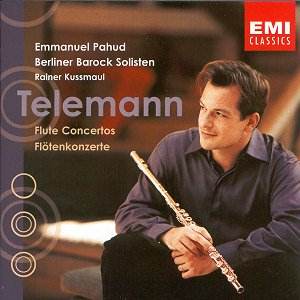
Georg Phillipp TELEMANN (1681-1767)
Concerto for flute in G major TWV 51: G2
Concerto for two flutes, violone, strings and continuo TWV 53:a1 (from Tafelmusik)
Concerto for transverse flute, strings and continuo, TWV 51:D2
Concerto for flute, oboe d’amore, viola d’amore, strings and continuo TWV 53:E1
Concerto for flute, strings and continuo in D, TWV 51:D2
Emmanuel Pahud, flute; Rainer Kussmaul, violin and leader; Georg Faust, cello; Wolfram Christ, viola d’amore; Klaus Stoll, violone; Jacques Zoon, flute; Albrecht Mayer, oboe d’amore.
Berliner Barock Solisten, Rainer Kussmaul, conductor.
Emmanuel Pahud, the Swiss-French flutist, who was, like his illustrious predecessor James Galway, the principal of the Berlin Philharmonic, has in recent years taken off on a spectacular solo career. Unlike his Irish counterpart, Pahud has yet to resort to pop music and gimmicks to sell records, and has released a series of nearly flawless recordings for EMI. I do not know of another classical artist active today whose recordings I will buy on release day, simply because he is on them. Pahud is one of the most solid, artistic and refined musicians in the world, and this splendid collection of concerti by Telemann has risen to the very top of my listening pile in very short order.
Telemann was the most respected composer of his generation. Admired and imitated by such stars as Bach and Handel, Telemann was monumentally prolific, leaving behind hundreds of cantatas, chamber works, keyboard and orchestral pieces. The highlight of this recital is the recently reconstructed concerto in G major TWV 51:G2. Through the painstaking work of Arn Aske and Ulrike Feld, a gem has been restored to the repertoire. Until 2000 this piece was thought unplayable as the manuscript, housed in the library at Rostock was all but unreadable. Acidic ink had eaten holes in the paper, obliterating notes and the ink had bled through pages upon which both sides of the paper were written. Further, there were huge portions of score missing where the pages were torn completely away. Through great effort and research into Telemann’s style in 1721 when this piece was composed, Aske and Feld were able to reconstruct the concerto enabling us to enjoy this lovely work again.
To my ears, there is not a flaw to be found in this recording. Telemann of course, was a master orchestrator and his writing for the soloists is perfectly idiomatic. The balance between the soloists and orchestra is excellent. The Berliner Barock Solisten is as tight an ensemble as I have ever heard. Intonation is perfect, balances right on and they have a wonderful sense of the elegance of this music. Soloists in addition to Pahud play beautifully and in the double and triple concertos there is a delightful sense of collegial give and take. Albrecht Mayer’s oboe d’amore sings with splendid contralto warmth in the E major concerto TWV 53:E1.
Recorded sound is right on the mark here, with excellent balance, lovely ambience and warmth. No flaws in the programme booklet either, with fascinating and informative notes by Ulrike Feld, complete biographies of the artist, and even a personnel list of the orchestra with details about their instruments. An absolute winner, this disc is not to be missed.
Enlaces:
31 octubre 2011
Mozart - Flute Quartets - E. Pahud


Cuarteto para flauta nº 1
El Cuarteto con flauta n.º 1 en re mayor, K. 285, de Wolfgang Amadeus Mozart es el primero de una serie de tres cuartetos escritos para el flautista aficionado Ferdinand de Jean, compuestos probablemente entre 1777 y 1778.
Estructura
Consta de tres movimientos:
Allegro, 4/4
Adagio, si menor, 3/4
Rondeau: [Allegro], 2/4
Ludwig van Beethoven tomó prestado material del primer movimiento para su Dúo para clarinete y fagot de 1792.
El «distinguido Adagio en si menor, [es] una romántica canción de trobadores que, en la brevedad de sus treinta y cinco compases, sugiere el futuro movimiento lento del concierto para piano en la mayor (KV 488)».
Cuarteto para flauta nº 2
El Cuarteto con flauta n.º 2 en sol mayor, K. 285a, de Wolfgang Amadeus Mozart es el segundo de una serie de tres cuartetos escritos para el flautista aficionado Ferdinand de Jean, compuestos probablemente entre 1777 y 1778; en efecto, esta composición figura inmediatamente después del Cuarteto con flauta n.º 1 en el catálogo Köchel.
Estructura
La obra consta de dos movimientos:
Andante, 3/4
Tempo di Menuetto, 3/8
Su interpretación suele durar doce minutos aproximadamente.
Cuarteto para flauta nº 3
El Cuarteto con flauta n.º 3 en do mayor, K. 285b, de Wolfgang Amadeus Mozart es el tercero y último de una serie de tres cuartetos escritos para el flautista aficionado Ferdinand de Jean. A pesar de que esta composición figura inmediatamente después de los cuartetos con flauta números 1 y 2 en el catálogo Köchel, fue escrita al parecer algunos años más tarde, posiblemente en 1781 o 1782.
Estructura
La obra consta de dos movimientos:
Allegro, 3/4
Andantino, tema con variaciones
Su interpretación suele durar quince minutos aproximadamente.
Cuarteto para flauta nº 4
El Cuarteto con flauta n.º 4 en la mayor, K. 298, de Wolfgang Amadeus Mozart es el último cuarteto con flauta mozartiano. A diferencia de los tres cuartetos previos, escritos para el flautista aficionado Ferdinand de Jean, está composición parece haber sido escrita como entretenimiento, en lugar de como encargo.
Estructura
La obra consta de tres movimientos:
Andante, tema con variaciones
Menuetto, re mayor, 3/4
Rondeau: [Allegretto grazioso], 2/4
El tercer movimiento destaca por su casi homorísticamente detallada indicación de tempo: «Rondieaoux: Allegretto grazioso, ma non troppo presto, pero non troppo adagio. Così-così—non molto garbo ed espressione».
En italiano, «Un rondó jocoso: Allegretto grazioso, pero no demasiado rápido, pero no demasiado lento. Así-así-con gran elegancia y expresión».
Su interpretación suele durar once minutos aproximadamente.
J. S. Bach - Complete Flute Sonatas - E. Pahud - T. Pinnock


Son 494 las obras que se conservan escritas por Bach para distintos instrumentos. Como ya se ha comentado, el compositor abarcó todos los géneros musicales, por lo que su obra instrumental se compone de cánones, sinfonías y suites orquestales, conciertos para instrumentos solistas y orquesta, sonatas para instrumentos solistas o con bajo continuo, o para trío, suites y partitas para instrumento solo, fugas, obras teóricas especulativas, preludios, tocatas, fantasías, ejercicios para pedal de órgano, pasacalles, canciones, arias, pastorales, corales, dúos, invenciones o caprichos. No hubo nada que escapara a la curiosidad y el afán de compilar y ordenar que caracterizaban al maestro de Leipzig. Toda la música instrumental, excepto los corales para órgano, es profana, y mucha de ella, especialmente, la destinada al teclado, de carácter didáctico, como El clave bien temperado BWV 846-893 y la serie de las suites inglesas-francesas y partitas compuestas por Bach para enseñar el arte de la composición a su hijo Wilhelm Friedemann Bach.
Enlaces:
CD 1
CD 2
Bach - Flute Sonatas Vol 1 & 2 - Janet See


Janet See

Janet See is one of today’s outstanding performers on baroque and classical flute. For over 30 years she has performed as a soloist, in chamber music, and in orchestras throughout North America and Europe.
In London, where Janet lived for 12 years, she played principal flute for Sir John Eliot Gardiner’s two orchestras, and with those groups recorded the complete Mozart Operas and Beethoven Symphonies as well as numerous other discs. While in London she also played principal flute for 'The Taverner Players', conducted by Andrew Parrott. In North America Janet plays principal flute with Philharmonia Baroque under Nicholas McGegan and has recorded Vivaldi and Mozart Concertos with that orchestra. She also performs frequently with the Portland Baroque Orchestra and as guest soloist with chamber music ensembles throughout the US and Canada.
Among her highly acclaimed recordings are the Vivaldi Concertos and the complete Bach Flute Sonatas, both recorded on the Harmonia Mundi label. Other labels she has recorded on include DG Archive, EMI, Erato, Hyperion and Phantom Partner.
Janet is on the Early Music Faculty at Cornish College of the Arts in Seattle and is an active and enthusiastic teacher of early flutes and also of interpreting the nuance and language of baroque and classical music on modern flute. She received her degree on the modern flute at Oberlin Conservatory, training with Robert Willoughby. Her post-graduate training was with Frans Vester in The Hague. Janet is a qualified teacher of the F.M. Alexander Technique, having trained in London with Walter Carrington. She currently lives on Bainbridge Island, Washington with her husband and son.
Enlaces:
Suscribirse a:
Entradas (Atom)


